This may not be the most exciting subject, but it directly affects day-to-day life in the Canary Islands. That alone makes it worth paying attention to.
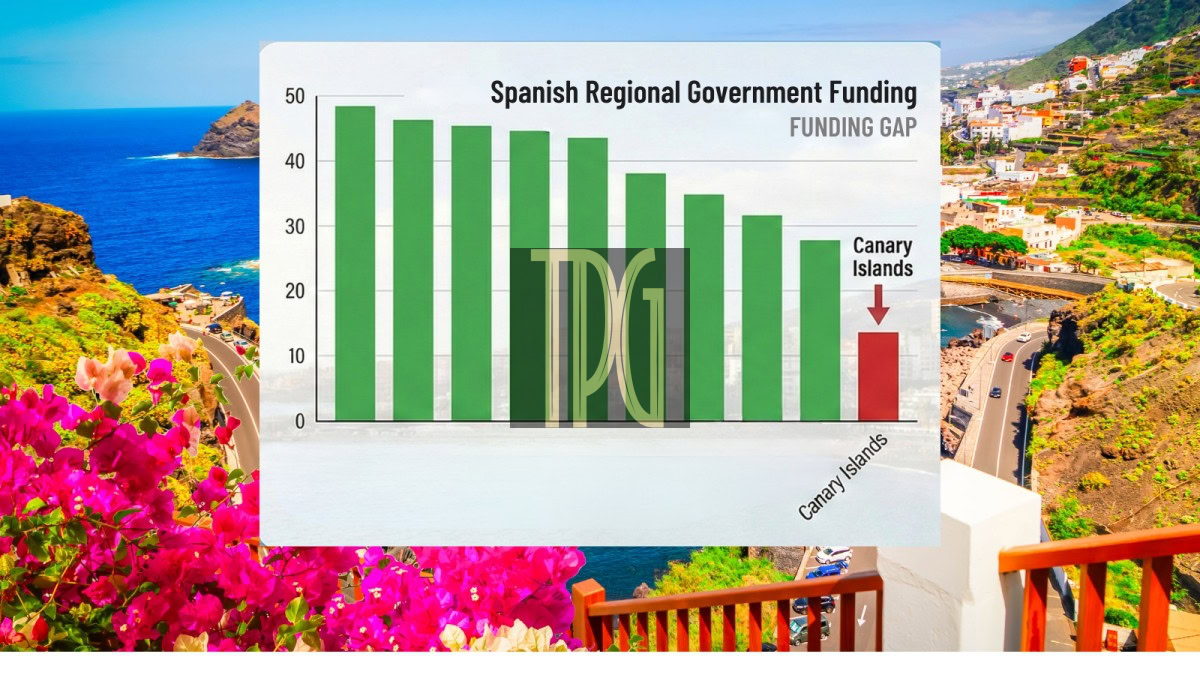
According to the Canary Islands Government, Spain’s proposed new regional funding model leaves Canarias as the only autonomous community that does not improve its position.
Everyone else moves forward.
The Canary Islands do not.
In fact, under the proposal, the region ends up worse off.
Everyone Else Gains. Canarias Doesn’t.
The warning came from Matilde Asián, the Canary Islands Councillor for Finance and EU Relations, following this week’s Council of Government meeting.
Her message was clear. All underfunded regions in Spain improve their relative position under the new funding model proposed by Finance Minister María Jesús Montero.
All of them, except the Canary Islands.
Yes, the overall funding gaps between regions are reduced.
Yes, underfunded communities benefit.
But Canarias is left sitting alone in 15th place in the distribution.
That is not progress by any measure.
More Money Promised… But Where Does It Come From?
On paper, the proposal includes an additional €20.9 billion to be shared across Spain’s autonomous communities.
Based on the Ministry’s own criteria, the Canary Islands would receive around €611 million.
At first glance, that sounds positive.
Until you ask the obvious question.
Where does the money actually come from?
Asián pointed out there are only two realistic answers. Either taxes increase, or public debt rises.
And higher debt, as she noted, is effectively higher taxes delayed for our children and grandchildren.
That is hardly reassuring.
The Real Issue Is in the Small Print
This is where the discussion becomes more technical, but also where the core problem lies.
Regional funding in Spain is largely based on what is known as “adjusted population”. This is the main factor used to determine how much money each region receives.
Under the new proposal, the Canary Islands lose ground here as well.
The insularity factor, which recognises the extra cost of delivering services across islands, has been reduced compared to previous calculations.
For an island region, that raises serious concerns.
A Sharp Drop in Adjusted Population Weight
When the figures are applied, the €611 million allocation suggests the Canary Islands would now account for just 2.9% of Spain’s adjusted population.
Previously, that figure was close to 5%.
That is a significant drop.
Asián also highlighted that many of the criteria behind these calculations have not yet been fully explained.
At present, the only clear change is the weakening of the insularity factor.
For an island territory, that undermines the entire logic of the model.
“Buying Time in Moncloa”
Government spokesperson Alfonso Cabello was even more direct in his criticism.
He argued that Spain’s central government, and Prime Minister Pedro Sánchez in particular, are using regional funding as a political tool.
Cabello described it as an attempt to buy time in Moncloa using the money of Canary Islanders, and ultimately, all Spaniards.
He also suggested the proposal feels more like pre-election manoeuvring than serious long-term planning.
You may not agree with that view.
But it is easy to understand where the frustration comes from.
Why This Actually Matters
It is easy to switch off when funding models and billion-euro figures are mentioned.
Most people do.
But these decisions do not stay theoretical for long.
They affect public services, infrastructure, healthcare, education, and how stretched local budgets become. When the Canary Islands fall behind in relative funding, the impact eventually shows on the ground.
Whether the proposal changes before it is finalised remains to be seen.
For now, the message from the Canary Islands Government is clear.
Under the current plan, Canarias loses out.
Again.